
What Semiconductor, Board, Firmware and Mechanical Hiring Looked Like in 2026
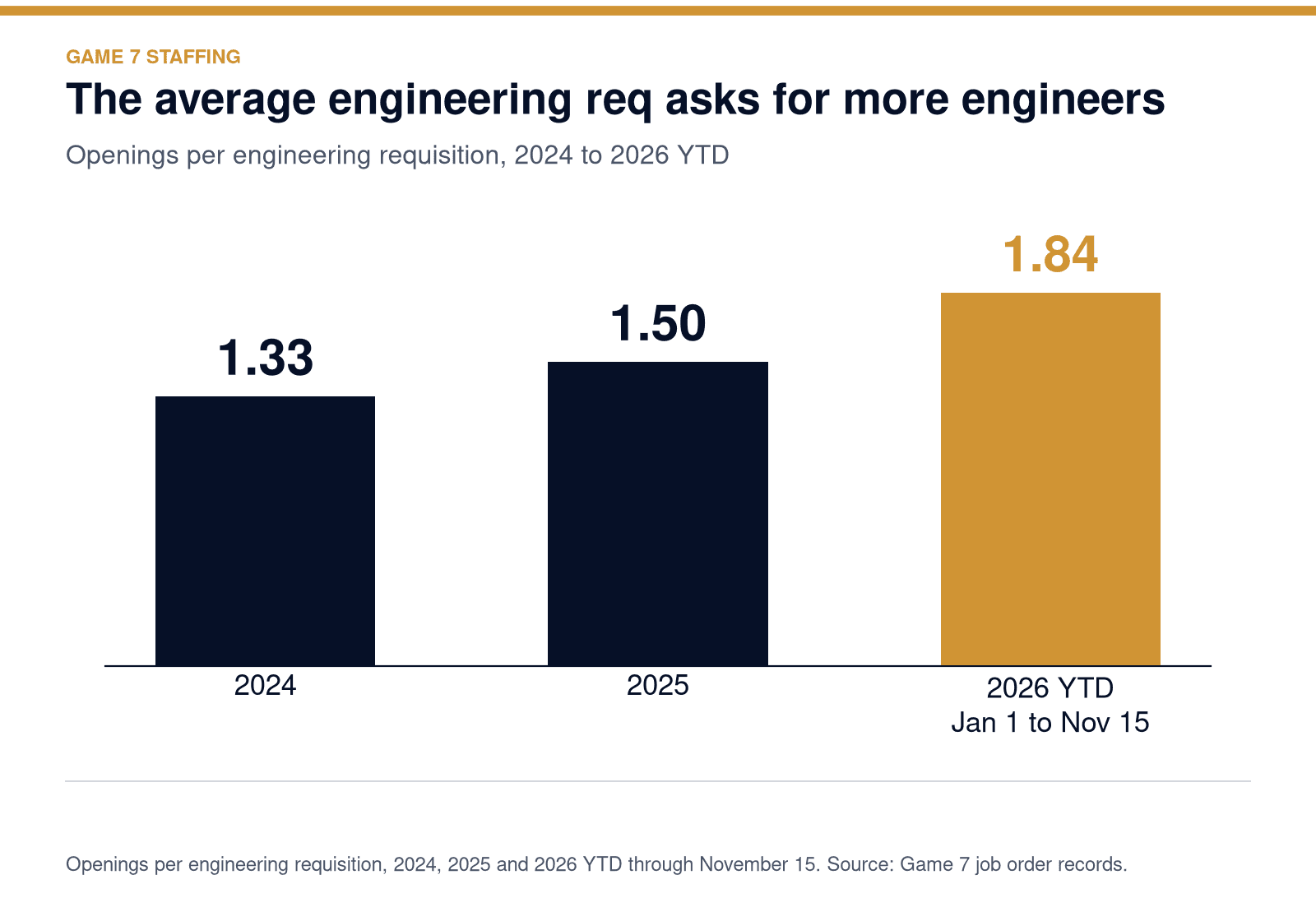
Through November 15, 2026, engineering reqs in Game 7's book asked for 1.84 openings on average. Here's what semiconductor, board, firmware and mechanical hiring looked like this year.
Publisher. G7 Labs, the research arm of Game 7 Staffing.
Window. Game 7 internal contract and contract-to-hire placement records, January 1 through November 15, 2026. Trailing-twelve-month windows are labeled on those charts. Interview-to-offer and offer acceptance are Game 7's own lifetime process metrics and are labeled as such. Speed figures come from Game 7's 2025 funnel.
Key findings.
- Through November 15, 2026, engineering reqs in Game 7's book asked for 1.84 openings on average.
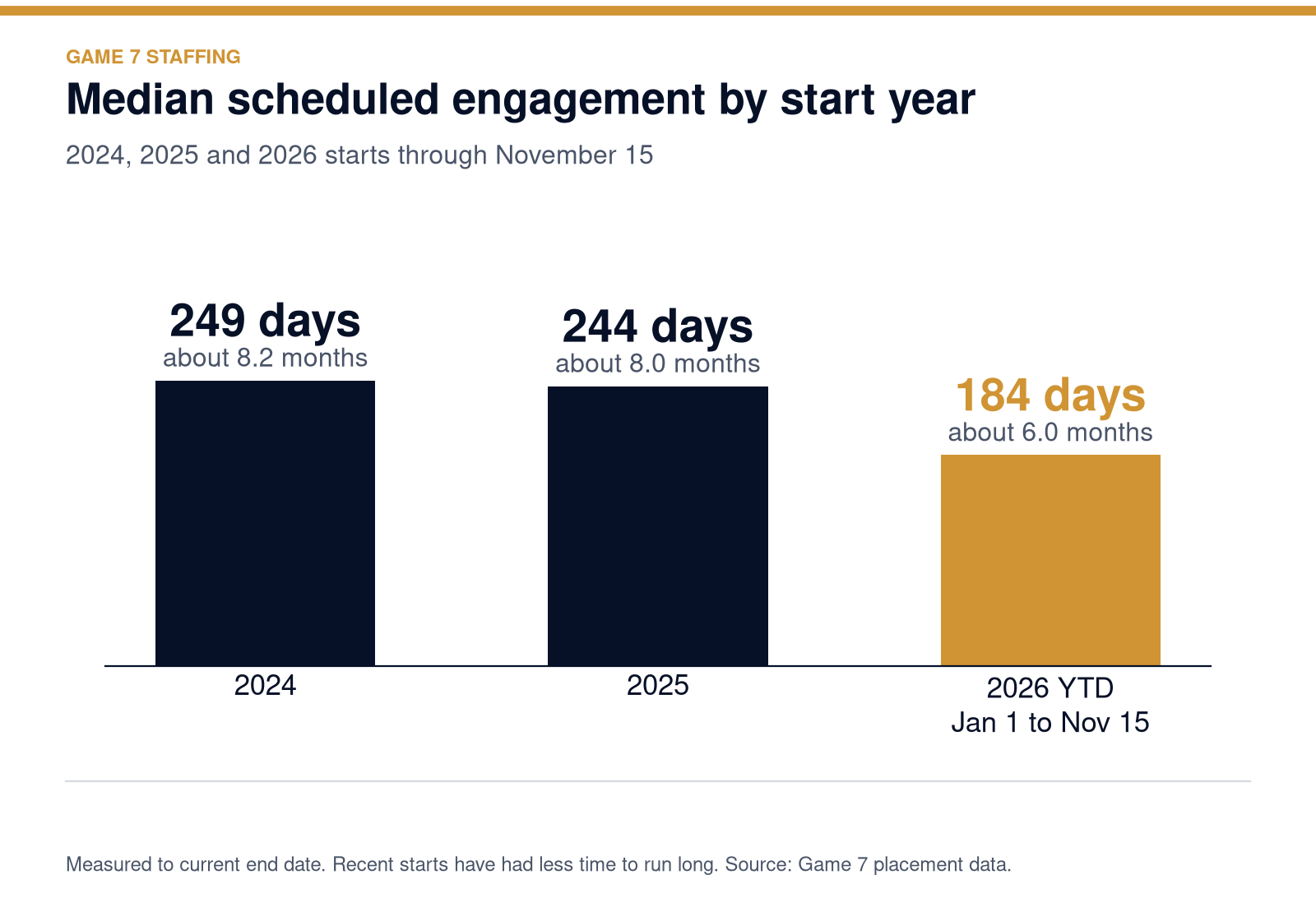
- Median scheduled engagement, measured to the current end date, is 184 days (about 6.0 months) for 2026 starts through November 15, 244 days (about 8.0 months) for 2025 starts and 249 days (about 8.2 months) for 2024 starts.
- As of November 15, 2026, 34.7% of running contracts have already run more than 12 months, and that group averages about 28 months end to end.
- 77 out of 100 placements run past the original end date.
- When engineering leaders interview Game 7 candidates, 2 in 3 get an offer. The 2 in 3 rate is a lifetime figure.
- Offer acceptance is 97%, a lifetime figure.
- The book-wide work-model split, on a trailing-twelve-month window through November 15, 2026, is 61% on-site, 9% hybrid and 30% remote.
If you are staffing semiconductor, embedded firmware, board-level hardware and mechanical engineers in 2026, the req on your desk probably isn't the one you wrote two years ago… and your interview calendar feels it. This year-to-date post follows semiconductor, embedded firmware, board-level hardware and mechanical hiring in Game 7's book from January 1 through November 15, 2026, and it's written for hiring managers and engineering leaders.
The Q3 Engineered Workforce report remains the quarterly snapshot for January 1 through August 31, 2026. The full 2026 picture comes in our Year in Review Intelligence report in January.
Your Average Req Is Asking for More Engineers
The figure that still organizes a hiring plan for semiconductor, embedded firmware, board-level hardware and mechanical seats is openings per requisition: the mean number of engineers a req in Game 7's book asks for.
The Q3 report, covering January 1 through August 31, 2026, published 1.33 openings per engineering requisition in 2024, 1.50 in 2025 and 1.78 in 2026 through August 31. The November 15 year-to-date figures are 1.33 in 2024, 1.50 in 2025 and 1.84 in 2026. By discipline, 2026 year to date through November 15 and directional, openings per requisition run 2.61 in mechanical, 2.24 in semiconductor, 1.53 in embedded firmware and 1.50 in board and hardware.
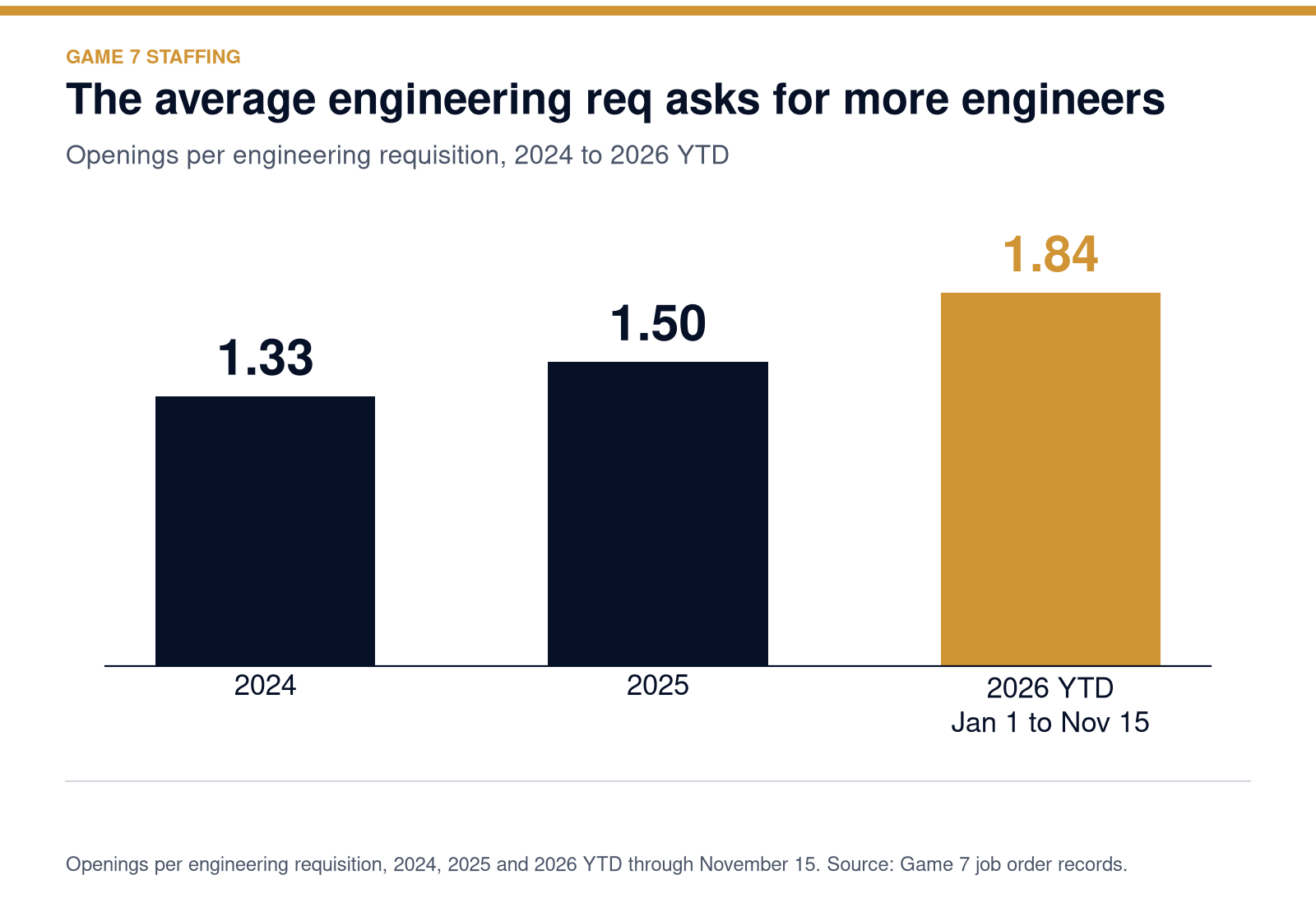
A one-person backfill and a three-seat req do not ask the same thing of your principals. Build the approval and the interview slate for the whole req, or the later seats wait on a calendar you already filled.
More than once this fall, the reason behind a req wasn't growth. It was a retirement or a departure, and the hiring manager needed someone who could run the tools on day one. Those reqs are scoped tight, which helps explain why some of them stay open for months.
Scheduled Spans and Long-Running Contracts
Scheduled length and the long tail answer different questions, and they belong in different columns. The first is how long a new start is scheduled to run, grouped by the year it began and measured to the current end date. The second is already running: contracts that have gone more than 12 months, how long that group has lasted end to end, and how often the work runs past the original end date.
Through November 15, 2026, median scheduled engagement, measured to the current end date, is 249 days (about 8.2 months) for 2024 starts, 244 days (about 8.0 months) for 2025 starts and 184 days (about 6.0 months) for 2026 starts. 2026 starts are scheduled shorter so far, and some will run longer before they end. Typical engagement by discipline, TTM through November 15, 2026, is about 9.9 months for Design Verification, about 6.1 months for Electrical / Hardware, about 5.8 months for Embedded / Firmware, about 5.0 months for IC Design and about 4.9 months for Mechanical, with DFT suppressed (thin sample).
The long tail is a different question. As of November 15, 2026, 34.7% of running contracts have already run more than 12 months, and that group averages about 28 months end to end.
77 out of 100 placements run past the original end date. That's the planning frame: the work keeps coming.
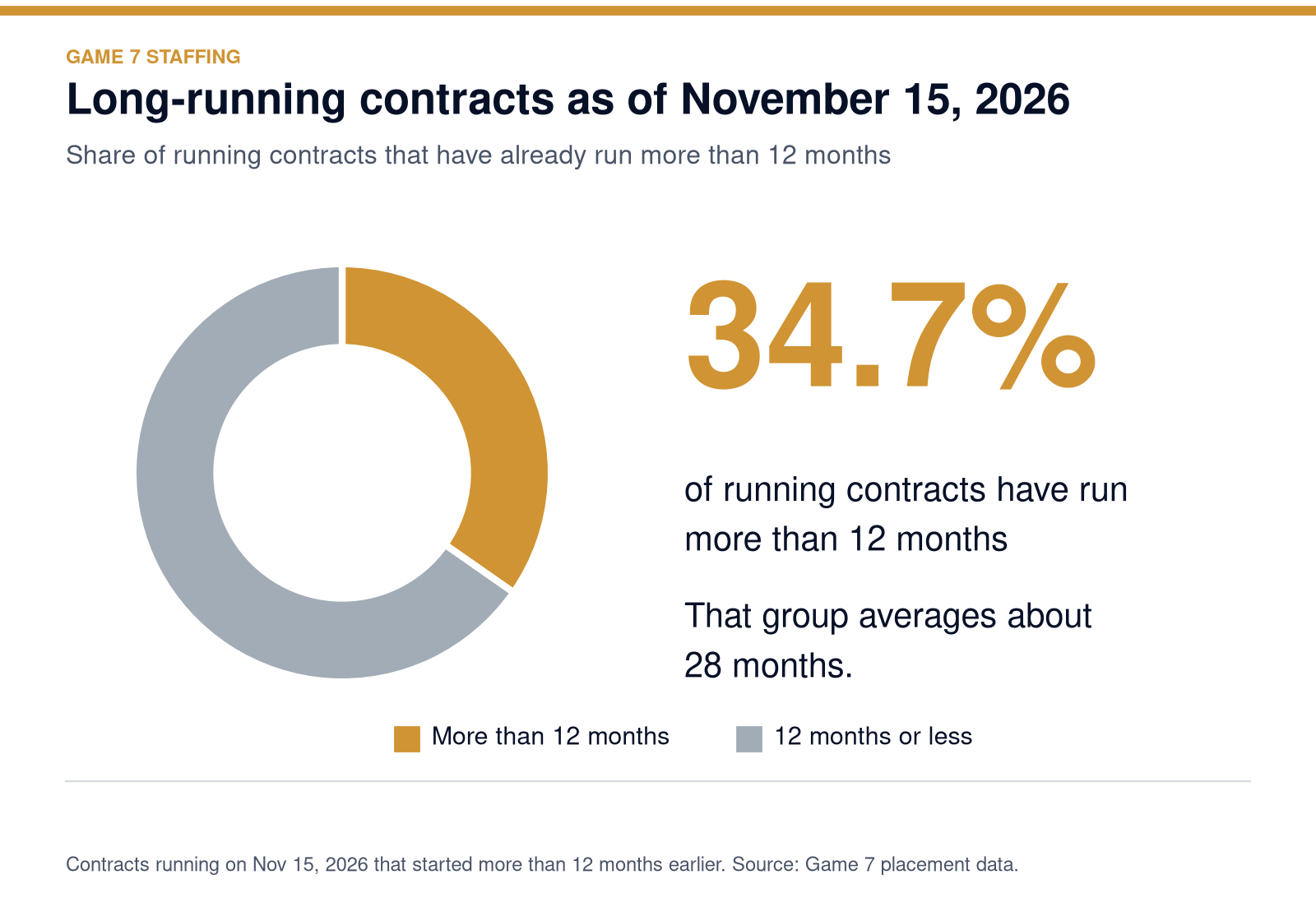
Use the scheduled-duration figure when you write the next scope. The long-tail panel, and the figure that 77 out of 100 placements run past the original end date, are the ones to reach for if you are asking whether the engineer will still be on the program a year from now.
On our intake calls, hiring managers keep describing the first contract as a starting commitment. Six months, maybe a year, with the business deciding the rest. We read the scheduled end date the same way... as a starting point, not a finish line.
What the Hour Costs, and How Long a Seat Usually Runs
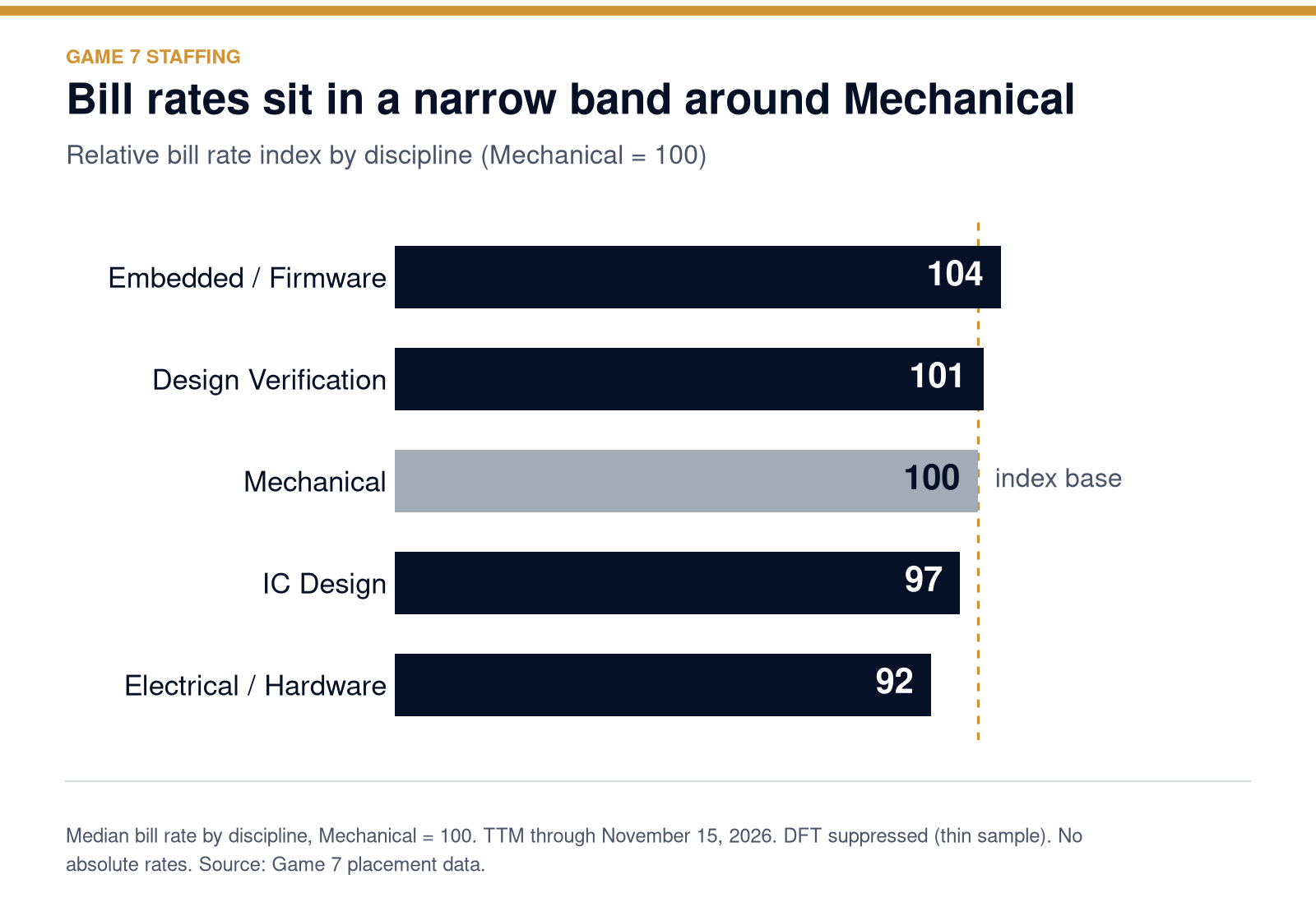
Relative bill rates in this book are indexed to Mechanical at 100, so the mechanical row is the index base. We don't publish absolute rates.
The Q3 report, on a trailing-twelve-month window through August 31, 2026, found that the most specialized disciplines, including Embedded / Firmware and Electrical / Hardware, billed within a few points of Mechanical. The scarce seat didn't always show up in the rate… it showed up in time to fill. On the window through November 15, 2026, the bill-rate index is Embedded / Firmware 104, Design Verification 101, Mechanical 100, IC Design 97 and Electrical / Hardware 92, the low end of the band, with DFT suppressed (thin sample). Those same figures sit in Figure 4 and the planning table.
The planning-view table puts premium, typical engagement and work-model skew on one page for semiconductor (Design Verification, IC Design and DFT), embedded firmware, board-level electrical and hardware and mechanical.
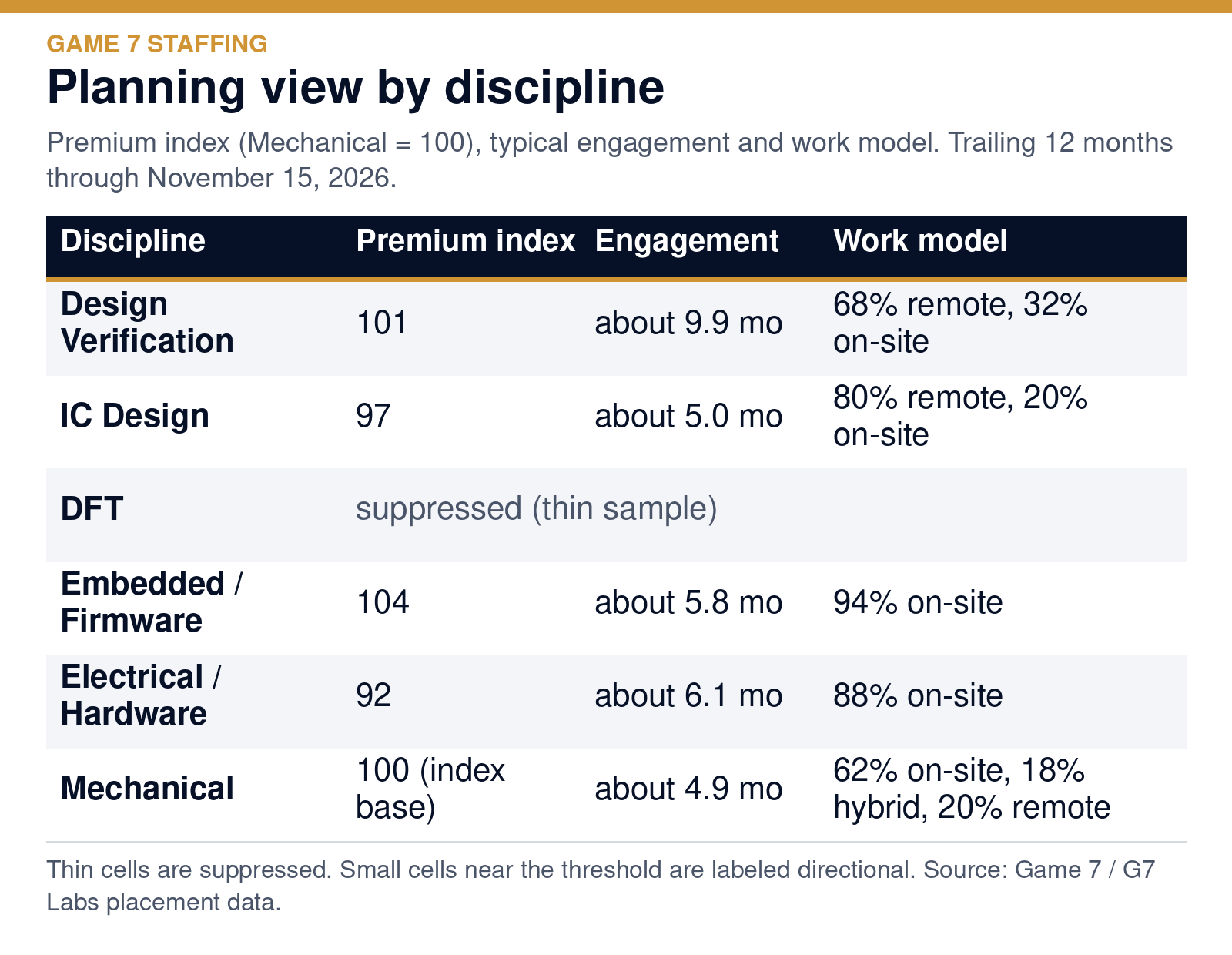
- Design Verification: premium index 101, typical engagement about 9.9 months, 68% remote and 32% on-site.
- IC Design: premium index 97, typical engagement about 5.0 months, 80% remote and 20% on-site.
- DFT: suppressed (thin sample) on all three measures.
- Embedded / Firmware: premium index 104, typical engagement about 5.8 months, 94% on-site.
- Electrical / Hardware: premium index 92, typical engagement about 6.1 months, 88% on-site.
- Mechanical: premium index 100 (the index base), typical engagement about 4.9 months, 62% on-site, 18% hybrid and 20% remote.
Window: trailing 12 months through November 15, 2026. Thin cells are suppressed. Source: Game 7 placement data.
Where the Work Happens
Work model is measured on the requisition's stated work model. The Q3 report published a book-wide split of 60% on-site, 11% hybrid and 29% remote for January 1 through August 31, 2026. The November 15 split, TTM through November 15, is 61% on-site, 9% hybrid and 30% remote. Figure 5 and the planning table show how that split changes by discipline.
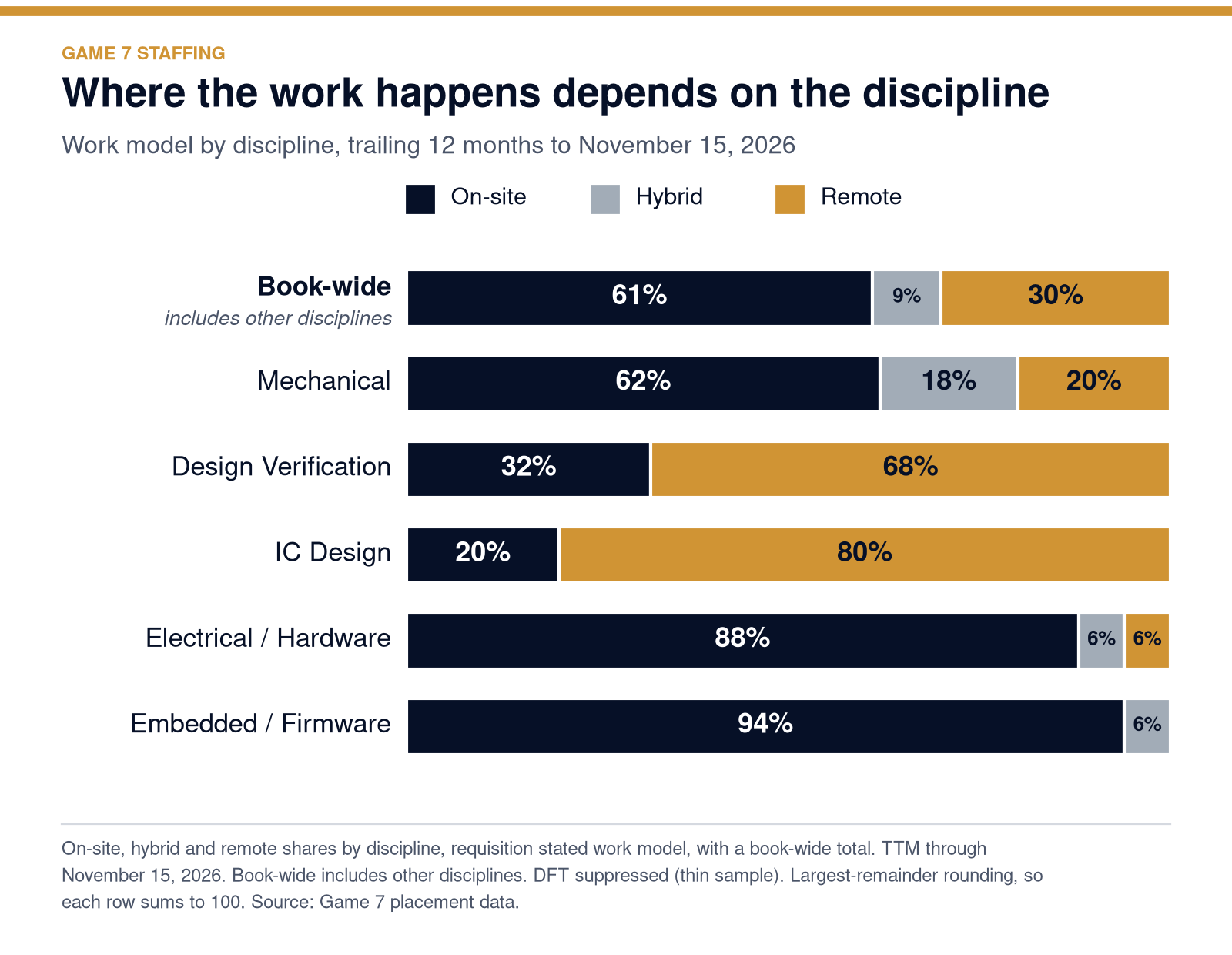
The hiring managers we talk to often need the work on site, five days a week. The PCB layout and opto-mechanical engineers we talk to keep telling us they want remote, and the commute is usually why. We sit in the middle of that gap every day, which is why where the work happens belongs in the req from day one.
The Q3 report's planning read is that work model is a discipline story, and that a remote-friendly req mostly widens a bench-anchored or fab-constrained pool into people who can't take the job. A remote-friendly posting will not invent bench capacity you do not have.
The November 15 table, TTM through November 15, has 98.3% coverage.
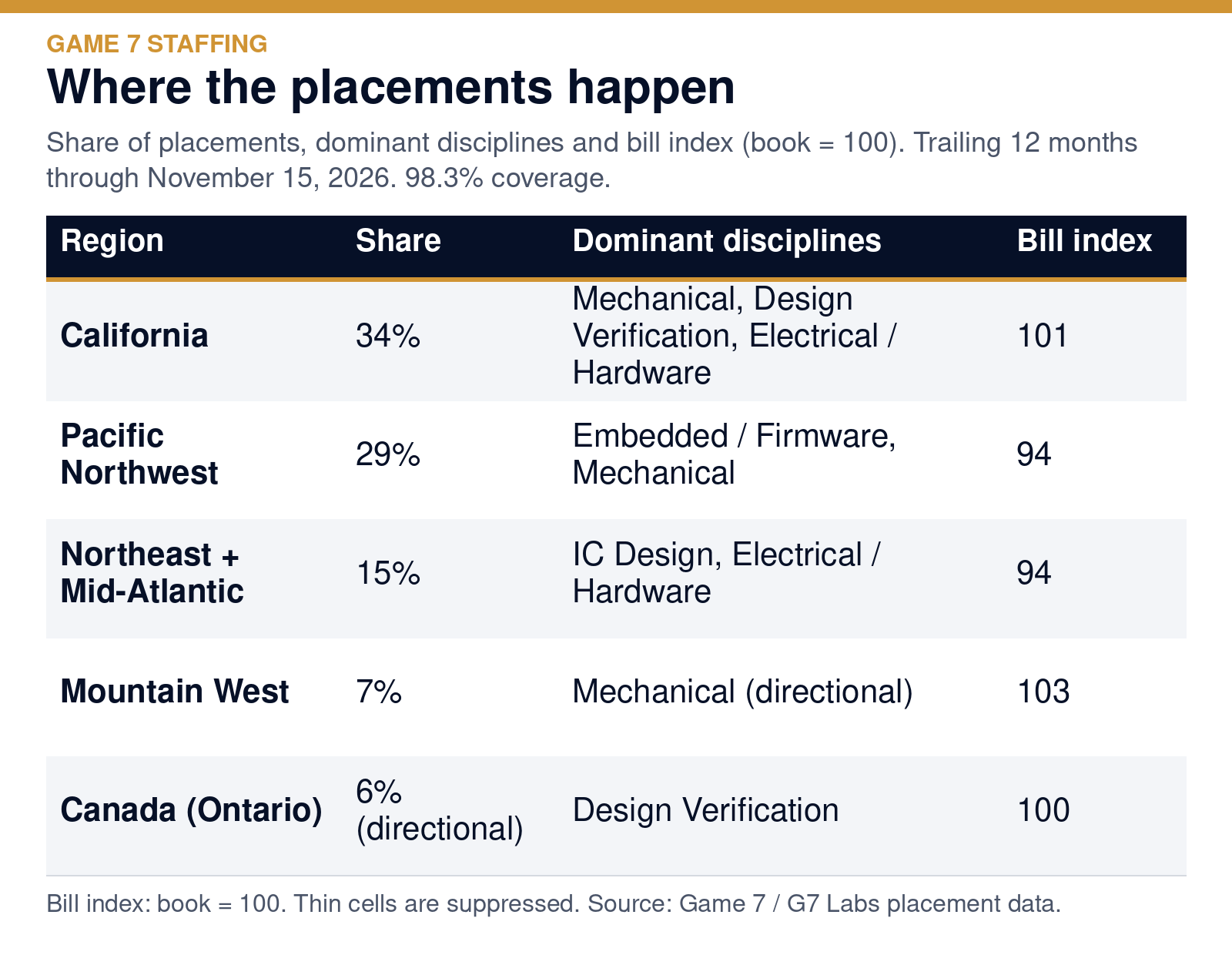
- California: 34% of placements, dominant disciplines Mechanical, Design Verification and Electrical / Hardware, bill index 101.
- Pacific Northwest: 29% of placements, dominant disciplines Embedded / Firmware and Mechanical, bill index 94.
- Northeast + Mid-Atlantic: 15% of placements, dominant disciplines IC Design and Electrical / Hardware, bill index 94.
- Mountain West: 7% of placements, dominant discipline Mechanical (directional), bill index 103.
- Canada (Ontario): 6% of placements (directional), dominant discipline Design Verification, bill index 100.
Window: trailing 12 months through November 15, 2026, 98.3% coverage. Bill index is book = 100. Thin cells are suppressed. Source: Game 7 placement data.
Once You Send Us a Req
Once the req is in our hands, this is Game 7's own process for semiconductor, embedded firmware, board-level hardware or mechanical work.
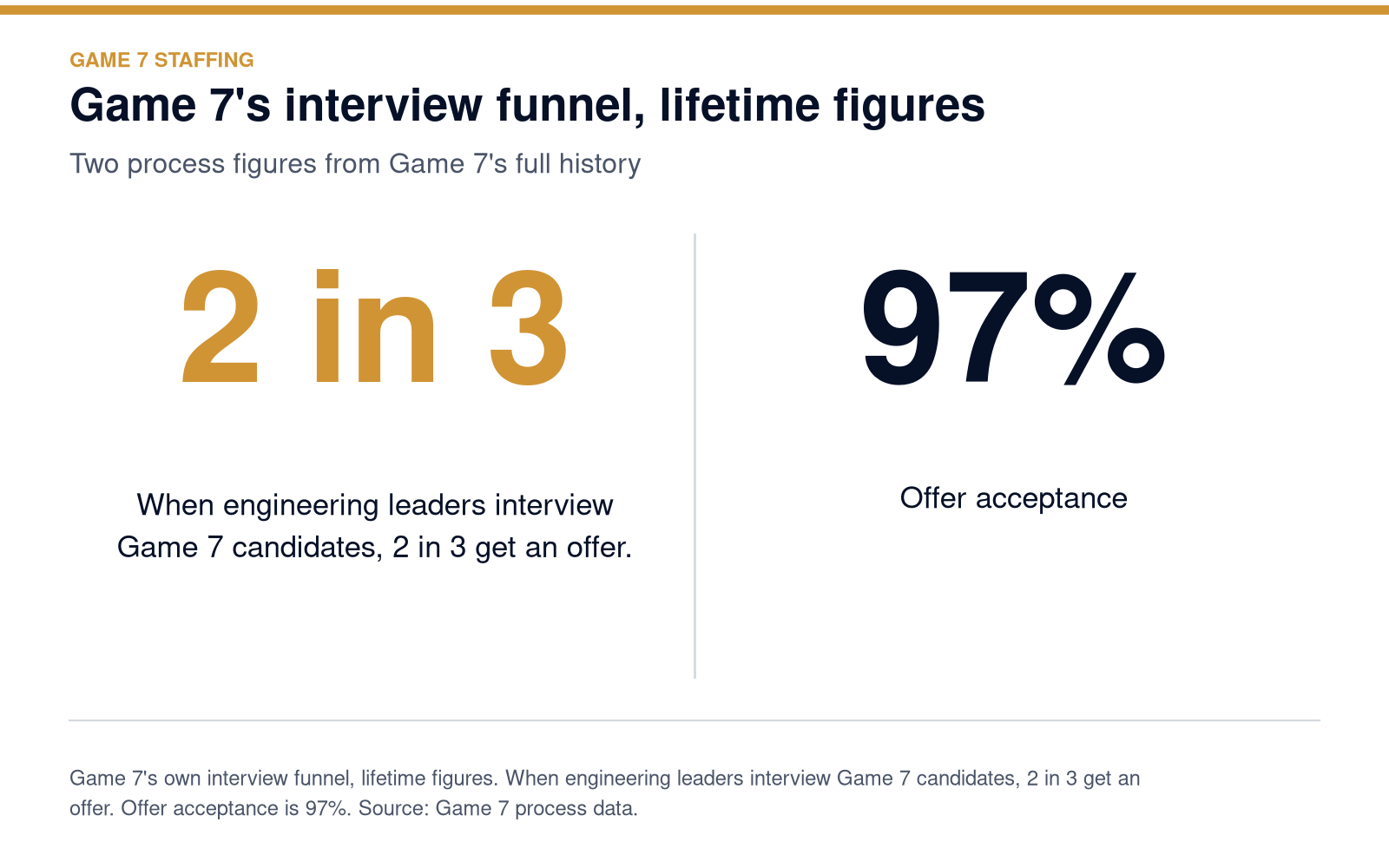
When engineering leaders interview Game 7 candidates, 2 in 3 get an offer. That is a lifetime figure. The hiring managers we talk to are interviewing three or four engineers for every offer they make. We're at two in three.
Offer acceptance is 97%, a lifetime figure.
In 2025, our time from job creation to first submission was under 24 hours. The 2025 median time to offer extended is 19 days. Interview slots on a tapeout-bound or build-phase program cost principal-level time, so the screen is a judgment screen. We send a shortlist of 2-4.
Methodology and Sources
This is a directional read on the segments Game 7 staffs.
Dataset. Game 7 contract and contract-to-hire placement, job-order, submission and candidate records. GA4 is traffic only. The book covers semiconductor, embedded firmware, board-level hardware and mechanical seats.
Windows. Year-to-date figures cover January 1 through November 15, 2026, unless a chart is labeled trailing twelve months. Prior-year comparables are full-year 2024 and 2025. The Q3 Engineered Workforce report remains the quarterly snapshot for January 1 through August 31, 2026.
What is counted. Openings per requisition are the mean engineers requested per engineering req. Figure 2 is median scheduled engagement by start year, measured to the current end date. Figure 3 counts running contracts already past 12 months and the average end-to-end span of that cohort. 77 out of 100 placements run past the original end date. Work model is the requisition's stated work model. The bill-rate index is median bill rate by discipline, Mechanical = 100, with no absolute rates. Process metrics are Game 7's own funnel and are labeled as such.
Publication rule. Discipline and regional cells meet a minimum sample size, and thin cells are suppressed. Small cells near the threshold are labeled directional.
Engagement method. Engagement length is the scheduled duration from start date to the current end date in Game 7 placement data, so it includes time added after a contract started. Long-running contracts are contracts still running on November 15, 2026 that started more than 12 months earlier. These measures were rebuilt for this update and don't line up exactly with how the Q3 report measured them. Compare figures within this post. Recent starts have had less time to run long.
The productivity research reviewed in the Q3 report predates this 2026 year-to-date placement data. McKinsey's June 27, 2023 study of more than 40 of its own developers found that time savings shrank to under 10% on high-complexity tasks. METR's July 2025 trial and its February 2026 update show how quickly those measurements move, with the later update leaning toward speedup on what METR calls an unreliable signal and only very weak evidence.
How many seats is your next req really asking for? And how many interview slots can your principals give it?
Tell us what the team is staffing and what the schedule looks like, whether you are hiring for semiconductor, embedded firmware, board-level hardware or mechanical work. We will come back with a shortlist of 2-4 engineers who match the work.
Game 7 is the contract staffing firm for mid, senior and principal chip, board, embedded firmware and mechanical engineers.
FAQ
Frequently Asked Questions
What is Game 7's 2026 year-to-date engineering hiring data?
It's G7 Labs' year-to-date roll-up of Game 7 Staffing's contract and contract-to-hire placement records, January 1 through November 15, 2026, covering semiconductor, embedded firmware, board-level hardware and mechanical hiring. The Q3 Engineered Workforce report covers January 1 through August 31, 2026. The full 2026 picture comes in our Year in Review Intelligence report in January.
How many engineers does the average engineering req ask for in 2026?
Through November 15, 2026, the year-to-date figure is 1.84 openings per requisition. The Q3 figure of 1.78 is the snapshot for January 1 through August 31, 2026, and it sits above 1.50 in 2025 and 1.33 in 2024.
Are contract engineering engagements getting shorter?
2026 starts are scheduled shorter so far, and some will run longer before they end. Through November 15, 2026, the medians are 184 days for 2026 starts, 244 days for 2025 starts and 249 days for 2024 starts. The long tail is a second fact. As of November 15, 2026, 34.7% of running contracts have already run more than 12 months, and that group averages about 28 months end to end.
How long do contract engineering engagements last in 2026?
Through November 15, 2026, median scheduled engagement, measured to the current end date, is 184 days (about 6.0 months) for 2026 starts, 244 days (about 8.0 months) for 2025 starts and 249 days (about 8.2 months) for 2024 starts. These are scheduled spans so far, and recent starts have had less time to run long. Typical engagement by discipline, TTM through November 15, 2026, is about 9.9 months for Design Verification, about 6.1 months for Electrical / Hardware, about 5.8 months for Embedded / Firmware, about 5.0 months for IC Design and about 4.9 months for Mechanical, with DFT suppressed (thin sample).
How many running contract engineering engagements have passed 12 months?
As of November 15, 2026, 34.7% of running contracts have already run more than 12 months, and that group averages about 28 months end to end.
When engineering leaders interview Game 7 candidates, how many get an offer?
When engineering leaders interview Game 7 candidates, 2 in 3 get an offer. Once an offer goes out, 97% are accepted. Both are lifetime figures, so neither is limited to the 2026 window in this post.
Do engineers stick around past end dates?
77 out of 100 placements run past the original end date, a Game 7 track-record figure. That's the planning frame: the work keeps coming.
Is it hard to hire embedded firmware engineers in 2026?
This is what we see in Game 7's book, not a national forecast. Embedded firmware is one of the four disciplines this year-to-date post follows through November 15, 2026. On the trailing-twelve-month window, those seats sit at the high end of the bill-rate index, at 104 against Mechanical at 100, typical engagement is about 5.8 months, and 94% of the firmware reqs are on-site. If you are hiring firmware engineers this year, name the location early.

Written by
Jason Eisenberg
Head of Marketing