
Engineering Staffing in Austin and the Temp Agency Question
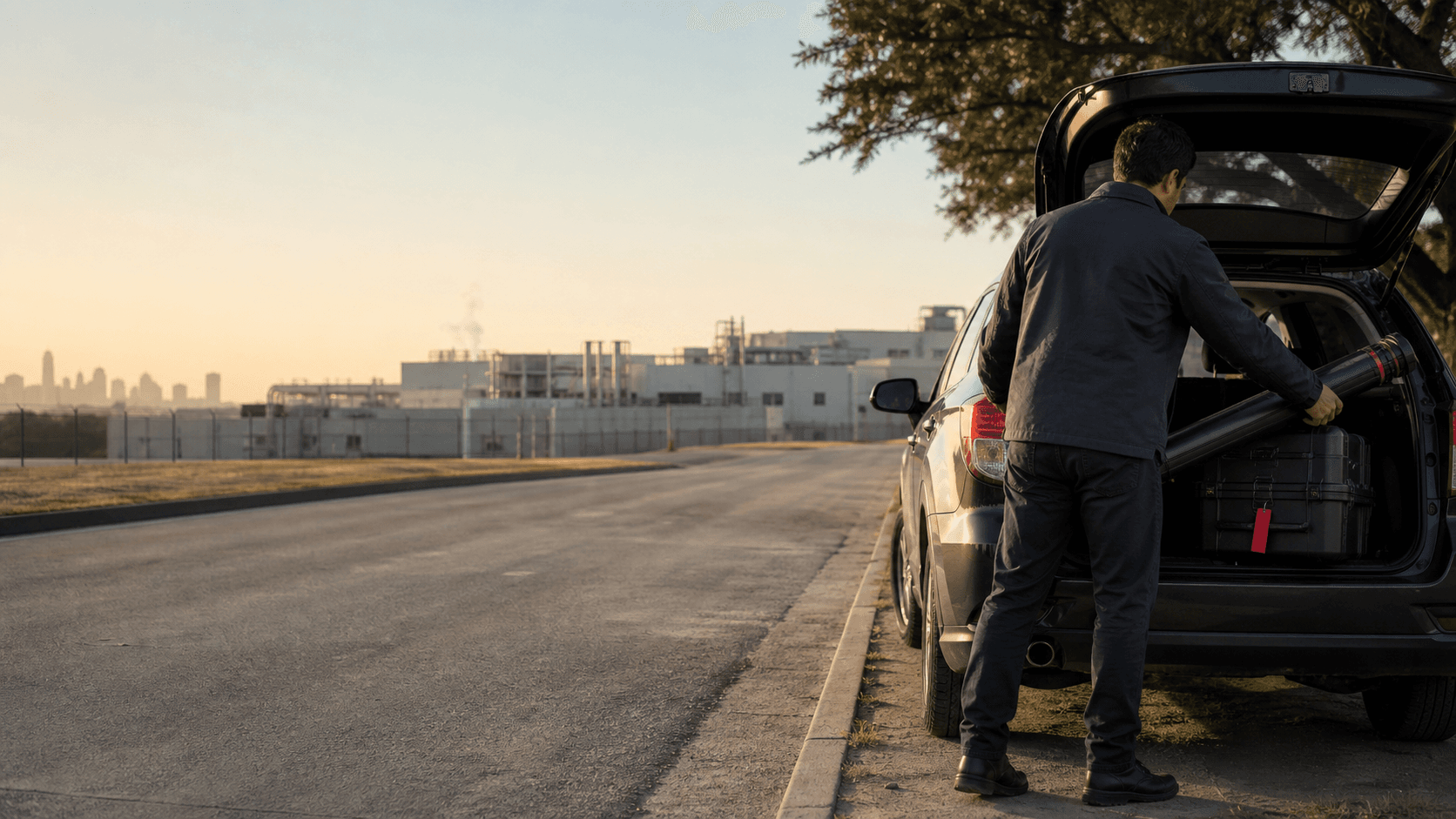
Samsung has been running fabs on the east side of Austin for thirty years. Our office is four miles from one of them, and more than 70 of our placements are inside driving distance. Here is what contract engineering actually looks like in this city, from both sides of the table.
Samsung built its first Austin fab in 1996, mirrored on the Hwaseong site back in Korea, and the company is marking thirty years in Central Texas this year. Two fabs on one east-side campus, roughly 4,500 people, more than $18 billion invested. For most of that time Austin got described to outsiders as a PC town with a music festival attached.
That description stopped being true a while ago. NXP runs its U.S. corporate headquarters here, along with two of the company's four American wafer fabs, turning out microcontrollers, power management devices, RF transceivers and sensors. AMD opened its Austin campus in 2008, 870,000 square feet on 58 acres, and had already been in town since 1979. Apple's Austin campus was announced with 6,200 employees already in the city, the company's largest population anywhere outside Cupertino. Samsung has committed at least $17 billion to a second Texas fab in Taylor, half an hour up 79, expected to create more than 2,000 jobs. And in February, Texas Instruments announced a $7.5 billion agreement to acquire Silicon Labs, an Austin-headquartered company with roughly 1,200 wireless connectivity products, with the deal expected to close in the first half of 2027.
Game 7 sits at 31 Navasota St, on the east side, four miles from Samsung's fab line. More than 70 of our placements are inside driving distance of that address: 56 in Austin proper and 15 up in Cedar Park, where Firefly Aerospace recently doubled its campus to 144,000 square feet for spacecraft assembly, avionics production and mission control.
So this piece is written from inside the city, for both halves of the audience that searches for it. Engineers looking for the next contract, and the teams trying to fill a seat before a date they cannot move.
Temp Agency? Sort Of. The Honest Version
People searching "temp agency Austin" are mostly not looking for us, and the ones who are usually flinch at the word. Fair enough. No principal-level DV engineer with fourteen years and three tapeouts thinks of themselves as a temp, and nobody should ask them to.
The category is real, though, and the honest answer is that contract engineering lives at the far end of it. Three things separate the two in practice.
Start with duration. Our engagements average around ten months, roughly 27 percent run past a year, and we see about 77 contract extensions for every 100 placements. Programs do not extend people they were merely tolerating.
Rate follows scarcity here rather than convenience, and the engineers we work with negotiate it that way... which is not a sentence you will find on a general staffing site.
Then the question that generates the most email: who actually employs you. Most of our contract engineers are W2 employees of Game 7, not 1099 contractors, with benefits available through us. It is worth reading what your options actually are before you assume contract means uninsured, because that assumption talks good engineers out of good work every year.
What contract engineering is not: a general labor pool, a bench of interchangeable people, or a bridge to a permanent role you are not allowed to ask about. If it feels like any of those three, that is a firm problem, not a category problem.
If You Are Hiring in Austin
The local talent math is unusual, and not in your favor.
Every engineer you want has a commute-length list of alternatives. A mechanical engineer with fab experience can drive to Samsung on the east side, NXP on William Cannon, or up to Taylor. A firmware engineer has NXP, Silicon Labs, and an Apple campus in the same metro. That is before Tesla's Austin operation and the AI-hardware teams that have quietly stood up satellite offices here since 2020. The hiring managers we talk to in this city rarely describe a sourcing problem. They describe a closing problem, and a timeline problem, and a quiet fear that the one candidate they liked in six weeks is already in a final loop somewhere else.
Contract works well here for a specific reason: the alternatives compete hardest on permanence, and permanence is slow. An offer that requires headcount approval, a leveling committee and a relocation package moves at one speed. A contract engagement moves at another. When your constraint is a fixed date, whether that is a tapeout, a qualification campaign or a customer sample, the faster instrument wins even if it is not the one procurement prefers.
Being local matters more than it should. We can put an engineer in a room on Tuesday. We know which east-side commutes people will actually accept and which ones quietly kill an offer in week three. We know who has been through a Samsung badging process and who has not. That knowledge is unglamorous and it saves entire weeks.
Our process runs the same here as everywhere else, and the numbers are measured and published rather than asserted: under 24 hours from job creation to first submission, a 19-day median to offer extended, and two in three engineers we put in front of a hiring manager walking out with an offer. If you have a seat open in Central Texas, tell us what you are building and which phase you are in.
If You Are an Engineer in Austin
Three areas are moving locally, and they are not the three you would guess from national coverage.
Mechanical and thermal is the loudest. Fabs, AI hardware and dense compute all bottleneck on heat and packaging, and the mechanical and thermal engineers we place tell us the interesting problems arrive early now, alongside the structure rather than after it. Cedar Park adds an aerospace flavor to the same skill set, where qualification campaigns and MIL-STD test programs run on their own schedule.
Design verification remains the largest team on any chip program, typically two or three DV engineers for every designer, and Austin has enough silicon in it to keep that ratio hungry. The verification engineers we place say the roles worth taking are the ones where somebody can tell you what coverage closure means on that project before you sign.
Embedded and firmware is the most Austin-specific of the three. Between NXP's microcontroller and i.MX ecosystems, Silicon Labs' wireless portfolio, automotive work in the metro and the connected-device companies that followed, this city runs on C, RTOS work, BSP bring-up and JTAG. The firmware engineers we talk to say bring-up experience on new silicon is what actually moves a conversation, more than any language on the resume.
One local note worth having. Some of the best-paid work in Central Texas sits behind ITAR restrictions or a clearance, particularly on the aerospace side north of the city. If you have either, put it at the top of your resume rather than the bottom. It changes which roles you can even be submitted for.
If you want to see what is open around here, take a look at our current roles.
FAQ
Frequently Asked Questions
Is Game 7 a Temp Agency in Austin?
Not in the way most people mean it. Game 7 is a contract engineering staffing firm headquartered in Austin at 31 Navasota St, placing mid, senior and principal-level engineers into semiconductor, embedded, hardware and mechanical programs. Engagements average around ten months and about 27 percent run past a year, so the work looks far less like temp placement and far more like joining a program for a phase of it. Contract engineers are W2 employees of Game 7 with benefits available through us.
What Kinds of Engineering Roles Are in Demand in Austin?
Three clusters come up most in Central Texas right now. Mechanical and thermal engineering, driven by fabs, AI hardware and dense compute where heat and packaging are the constraint. Design verification, because DV is typically the largest team on any chip program at two to three engineers per designer, and Austin has a lot of silicon in it. Embedded and firmware, shaped by the local microcontroller, wireless and automotive ecosystems, where bring-up experience on new hardware is the strongest signal.
Which Semiconductor Companies Are in Austin?
Samsung has operated fabs on the east side of Austin since 1996 and is building a second Texas fab in Taylor. NXP runs its U.S. corporate headquarters in Austin along with two of its four American wafer fabs. AMD has had an Austin presence since 1979 and opened its 870,000 square foot campus in 2008. Apple's Austin campus is the company's largest site outside Cupertino. Silicon Labs is headquartered in Austin and is being acquired by Texas Instruments in a deal announced in February 2026. Tesla also operates in the metro.
Do You Only Place Engineers in Austin?
No. Game 7 places engineers nationally across semiconductor, aerospace and defense, automotive, AI and compute, wireless and networking programs. Austin is where the company is based and where a large share of placements happen to sit, more than 70 in the metro including Cedar Park, which means local hiring gets the advantage of people who know the commutes, the badging processes and the competing offers in this specific city.

Written by
Jason Eisenberg
Head of Marketing