
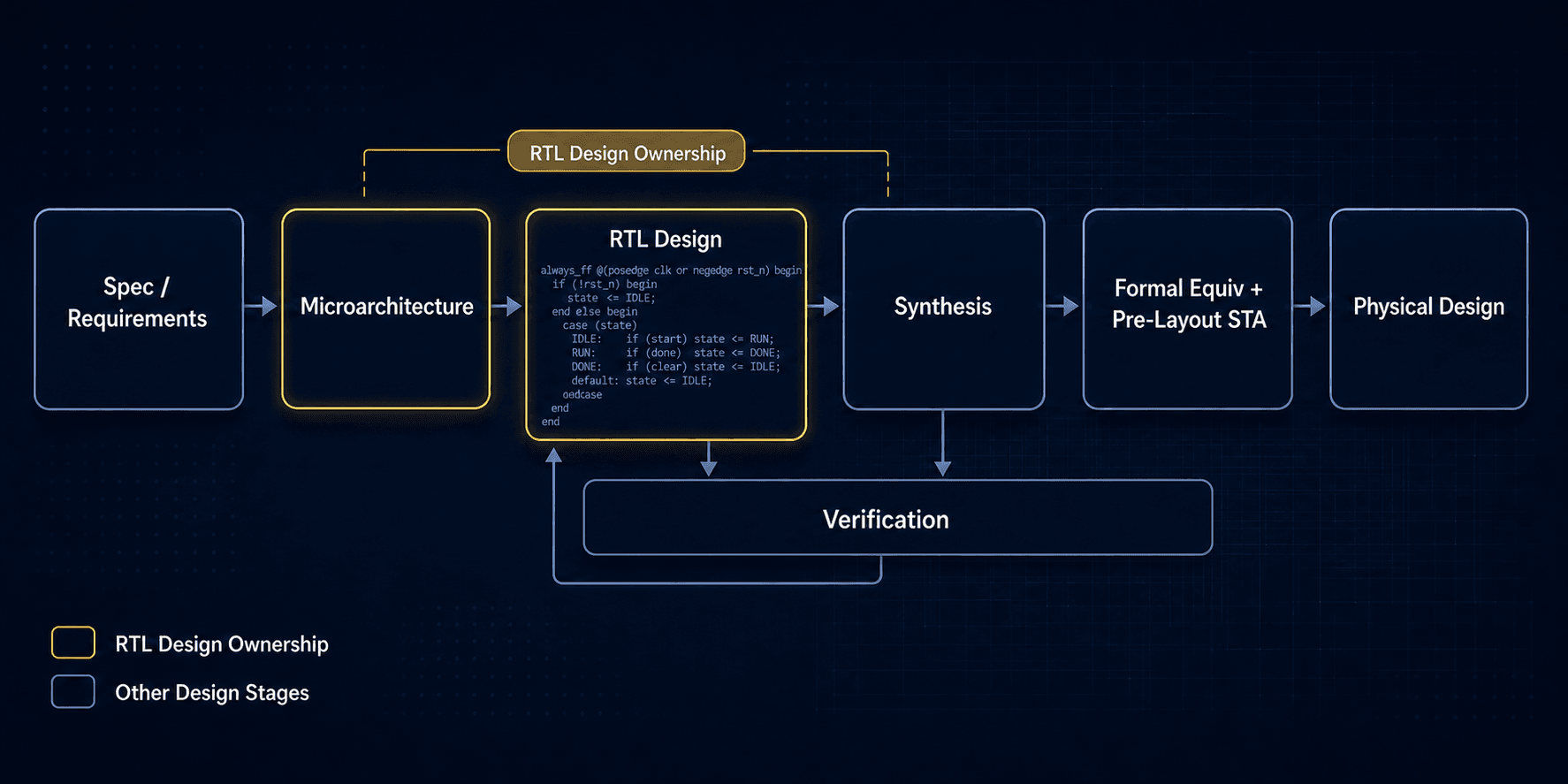
Anyone competent can express logic in SystemVerilog. RTL design is the judgment on top of the language: microarchitecture, timing intent, power intent, and a clean handoff to DV and PD. Here is what separates a block owner from an HDL coder, the senior-versus-principal signal, and how to screen for ownership instead of line count.
A resume that reads “SystemVerilog, 9 years” tells you almost nothing about whether the engineer can own a block. It might describe someone who has spent nine years coding to microarchitecture specs other people wrote. It might describe someone who has defined those specs, made the tradeoffs, and taken the block to silicon. On paper the two look identical. At integration, eight weeks later, they do not.
Writing synthesizable HDL is the mechanical floor of the job. RTL design is the judgment stacked on top of it: deciding what logic should exist, how it should be structured for timing and power, and how it hands off clean to verification and physical design. Screen for the language and you will hire coders. Screen for the discipline and you will hire designers. Here is how to tell them apart.
What Separates RTL Design From “Writes HDL”
Expressing logic in Verilog or SystemVerilog is a solved skill for any competent engineer. The hard part happens before a line is written: deciding what the logic should be. That decision-making shows up in three places.
- Microarchitecture. Pipeline depth, FSM structure, buffering and backpressure, interface and bus protocols, how a block partitions. A designer chooses these deliberately against power, performance, and area targets, and can tell you why each choice was made.
- Timing intent. Writing RTL that will actually close timing after synthesis, not just code that simulates correctly. That means pipelining the critical paths, and knowing what synthesis will fix through technology mapping and optimization versus what it will not.
- Power intent. Designing for clock gating and power domains from the start and expressing it, often through UPF, rather than treating power as something the back end deals with later.
An HDL coder produces code that simulates. An RTL designer produces a block that closes timing, meets its power budget, and drops into the SoC without a fight. The gap between the two is invisible in an interview that only checks syntax, and it becomes visible at synthesis and integration, which is the most expensive place to find it.
The Senior vs. Principal RTL Signal
Both levels are valuable, and hiring the wrong one for the work is a common and costly mismatch. A senior digital design engineer writes clean, synthesizable RTL for a well-defined block spec handed to them. They understand synthesis constraints and they deliver. For a well-specified block on a schedule, that is often exactly who you need, and paying principal rates for it is waste.
A principal defines the microarchitecture of a subsystem, makes the PPA tradeoff calls, architects the clock-domain-crossing strategy, owns the interface protocols, and has done all of it across multiple tapeouts on advanced nodes. The tell is that they can explain why they chose a specific pipeline depth, not just what they implemented. They also reason across block boundaries, about how their clocking, interfaces, and area budget affect their neighbors. Hand subsystem ownership to a strong senior who needs a spec written for them and the work stalls, because no one is writing the spec. Match the level to what the program actually requires.
Tooling and Handoff Reality
The language question is a fast filter. SystemVerilog and Verilog dominate digital design, with VHDL common in defense, aerospace, and FPGA work. A real RTL engineer talks fluently about SystemVerilog constructs such as interfaces, assertions, and packages. Someone who lists “Verilog” but cannot go past module-and-wire is a flag. So is anyone who describes a scripting language as their primary design skill; Tcl drives the EDA tool flow and Python shows up around it, but the design itself lives in HDL.
Clean RTL also has to survive the checks that come after it. It passes lint, in tools like SpyGlass or Real Intent, and it holds up under clock-domain-crossing analysis. CDC matters more than almost anything else on this list, because many of the verification escapes that kill chips happen at clock-domain boundaries. An engineer who has never handled a multi-clock design has a real gap, not a stylistic preference.
RTL does not live alone, and the best designers write for the people downstream. Their code is structured so verification can actually cover it, assertion-rich and testbench-friendly, and it is synthesizable and constraint-aware through SDC so synthesis and physical design can close it. Ask a candidate how they have worked with DV and with PD, not just what they coded. Code that DV cannot verify or that PD cannot close creates cost that lands on other teams and shows up as schedule.
How to Screen for Block Ownership, Not Line Count
A résumé lists tools and years and hides the one thing you need to know: did this person own a block, or fill in someone else’s. These questions surface the difference quickly, because they are easy to answer for someone who has done the work and nearly impossible to fake.
- “Walk me through a block you owned from spec to netlist. Which microarchitecture decisions did you make, and why?” Listen for pipeline, FSM, and interface reasoning tied to PPA tradeoffs.
- “How did you handle clock domain crossing on a multi-clock design?” You want synchronizer strategy, a CDC methodology, and the tool flow. A coder has no real answer.
- “What is the difference between behavioral and synthesizable RTL, and where has the gap burned you?” A thirty-second fundamentals check with a war story attached.
- “What did synthesis do to your design that you did not expect, and how did you fix it?” This surfaces real timing-closure judgment rather than textbook knowledge.
- “How did you structure the RTL to make DV’s and PD’s jobs easier?” Handoff awareness separates a team player from a lone coder.
What a designer sounds like: specific decisions, with reasons and tradeoffs. What a keyword match sounds like: a list of tools and “I wrote the RTL for X,” with no ownership underneath it.
When a Contract RTL Engineer Is the Right Call
Front-end demand pulses with the design phase. You need RTL depth heavily during microarchitecture and bring-up, and again during ECOs, and less in the stretches between. Contract fits that shape well: a defined block or subsystem to build on a schedule, a gap to cover after a mid-project departure, or a new subsystem that needs principal-level microarchitecture ownership your core team cannot spare. Contract RTL designers who have taped out across several companies bring a pattern library for CDC, interfaces, and the synthesis pitfalls that trip up first-timers. Keep the work full-time where the RTL is core, reused IP that needs ownership for years.
The scarcity is real and worth planning around. Deloitte projects a global semiconductor workforce shortage of more than a million people by 2030, with the US shortfall weighted toward engineering roles and demand specifically surging for RTL engineers (Deloitte). A principal RTL designer with advanced-node tapeout experience is one of the hardest hires in the industry, which is exactly why fill speed and screening quality matter. Game 7’s funnel for principal-level chip, board, and embedded engineers runs under 24 hours to first submission and a 19-day median to offer, and two in three of the engineers we put in front of a hiring manager get an offer, so your team is not spending its own design hours interviewing to get to a hire.
If you have an RTL block or subsystem that needs an owner and a schedule that will not wait, that is the search we run. Tell us the block, the node, and where it sits in the flow, and we will put a shortlist in front of you.
FAQ
Frequently Asked Questions
RTL Designer vs. Verification Engineer - Who Do I Actually Need?
They are different disciplines. An RTL design engineer builds the block: microarchitecture, synthesizable RTL, timing and power intent. A verification (DV) engineer proves the block matches its spec, building testbenches and closing coverage, usually in UVM. Most programs need both, and the teams are often two to three times larger on the DV side. If your gap is “the logic isn’t built,” you need RTL; if it is “we can’t prove the logic is correct,” you need DV.
Is a Strong Verilog Coder the Same as an RTL Design Engineer?
No. Coding synthesizable HDL is the mechanical floor. RTL design adds the judgment: choosing the microarchitecture, writing for timing closure and power, handling clock-domain crossings, and handing off clean to DV and PD. A capable coder who has only ever built to someone else’s spec may not be able to own an underspecified block.
What Is the Difference Between a Senior and a Principal RTL Engineer?
A senior writes clean, synthesizable RTL for a well-defined block spec they are given. A principal defines the microarchitecture of a subsystem, makes the PPA tradeoffs, owns the CDC strategy and interface protocols, and has done it across multiple advanced-node tapeouts. If the work needs someone to write the spec, not just implement it, you need a principal.
Should I Hire an RTL Engineer on Contract or Full-Time?
Use contract when the need is pulsed: a defined block on a schedule, a mid-project gap, or principal-level microarchitecture ownership your team cannot spare. Use full-time where the RTL is core, reused IP that needs multi-year ownership. Many programs do both, keeping core IP in-house and surging design-phase depth with contract engineers.
What Should I Screen for in an RTL Design Interview?
Block ownership, not line count. Ask them to walk through a block they owned from spec to netlist and justify the microarchitecture, how they handled clock domain crossing, what synthesis did that surprised them, and how they structured RTL for DV and PD. Specific decisions with reasons signal a designer; tool lists signal a coder.
Written by
Game 7 Staff