
What DO-254 and DO-178C Experience Is Worth to Your Career

DO-178C and DO-254 experience is a hard gate that keeps the qualified pool small. Why the premium holds, and how to present it on a resume.
Is DO-178C Experience Valuable for an Engineer’s Career?
Yes, and durably. Programs certifying at DAL A or B can’t substitute engineers who lack prior certification evidence. MC/DC coverage closure, requirements traceability, and tool qualification are hard gates, not preferences. That keeps the qualified pool small and slow to grow, which is exactly what sustains a premium. Paired with a security clearance, certification experience is one of the strongest compound premiums in embedded and hardware engineering.
Why Certification Experience Compounds
Avionics and defense programs run five to fifteen years, and the certification skill is evidence-based. You learn to close structural coverage, defend a traceability matrix, and qualify a tool by doing it on a real program under audit, and there’s no shortcut in. A bootcamp can’t manufacture DAL A evidence, and a commercial project won’t generate it. The only way into the pool is through the work, so the pool grows about as slowly as the programs themselves.
What DAL A/B Ownership Signals
Listing “DO-178C DAL A” on a resume claims something specific, and a hiring Chief Engineer reads it that way. The FAA recognizes DO-178C through AC 20-115D and DO-254 through AC 20-152A. The table below is the honest version of what each level implies about what you owned.
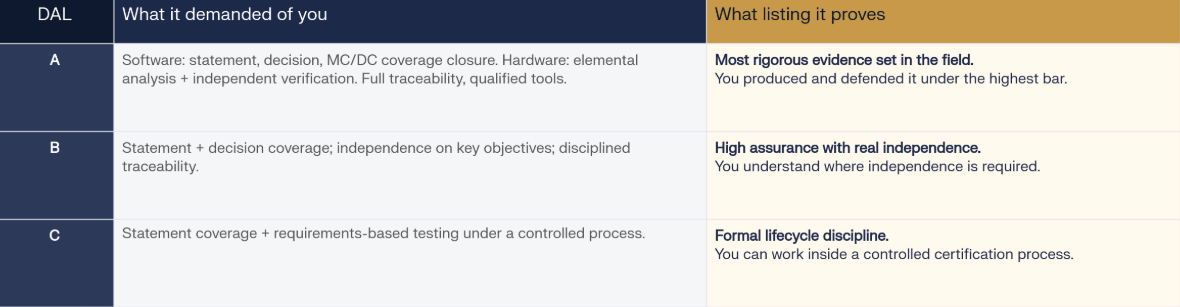
A precision point worth getting right on your resume
MC/DC is a DO-178C software objective at DAL A (the FAA/NASA MC/DC tutorial is the reference engineers actually cite). DO-254 hardware doesn’t use MC/DC; it relies on elemental analysis and independent verification. Claiming “MC/DC on an FPGA program” signals you’ve mixed up the standards, and the people hiring for this work will catch it.
The Premium Mechanics
The economics are simple to state. A hard gate on entry, plus a pool that can’t expand quickly, equals leverage that doesn’t decay with the market cycle. When commercial hiring cools, the certification pool is still small and the programs still have multi-year schedules to protect, so demand for proven certification engineers holds up better than demand for generalist embedded work. The value is in the scarcity, and the scarcity is structural. On our own desk, aerospace and defense is the fastest-growing vertical right now, which is a fair sign this demand isn’t softening.
The Compound Premium: Certification Plus Clearance
Stack a security clearance on top of certification experience and you land in the smallest, hardest-to-fill pool in embedded and hardware engineering. A cleared engineer who can also show DAL A/B evidence clears two independent gates at once, and programs that need both will wait for that profile rather than compromise on either. If you’ve read the clearance-value post, this is the same scarcity logic multiplied.
Commercial to Defense: What Transfers and What Doesn’t
Coming from commercial embedded or FPGA work, your engineering transfers cleanly. RTL, firmware in C, verification instincts, debugging across the hardware/software boundary, all of it carries. The learning curve is the evidence discipline: writing to traceable requirements, producing review records, closing coverage to an objective instead of to “looks done,” and treating the process as part of the deliverable rather than friction. Engineers who make the jump well tend to be the ones who stop seeing the paperwork as overhead.
Presenting Certification Work On a Resume
List the artifacts you owned, not the processes you sat near. “Closed MC/DC coverage on a DAL A flight-control component” says more than “familiar with DO-178C.” Name the standard and level, name what you produced (traceability, structural coverage, tool qualification data), and be accurate about the assurance level you actually worked to. Specific ownership is what separates a credible certification resume from one that gets filtered out in the first pass. Our resume guide covers the format in more depth.
Where This Fits
If you want roles where DO-254/DO-178C depth is the point rather than a line-item, see what we’re hiring for or reach out and discover what we have that requires clearance.
FAQ
Frequently Asked Questions
Is DO-178C experience valuable for an engineer’s career?
Yes, and durably. Programs certifying at DAL A or B can’t substitute engineers without prior certification evidence: MC/DC coverage closure, requirements traceability, and tool qualification are hard gates, not preferences. That keeps the qualified pool small and slow to grow, which is exactly what sustains a premium. Paired with a security clearance, certification experience is one of the strongest compound premiums in embedded and hardware engineering.
What is DAL A experience worth?
DAL A is the highest design assurance level, tied to failure conditions that could be catastrophic, so it carries the heaviest evidence burden and the smallest pool of engineers who have delivered it. That scarcity sustains a durable premium. The value shows up as leverage that holds through market cycles rather than as a single fixed number, and it compounds when combined with a security clearance.
Does commercial embedded experience transfer to defense certification work?
The engineering transfers: RTL, C firmware, verification, and cross-boundary debugging all carry over. The learning curve is the evidence discipline, writing to traceable requirements, producing review records, and closing structural coverage to a defined objective. Engineers who adapt to treating process as part of the deliverable make the transition well.

Written by
Jason Eisenberg
Head of Marketing