
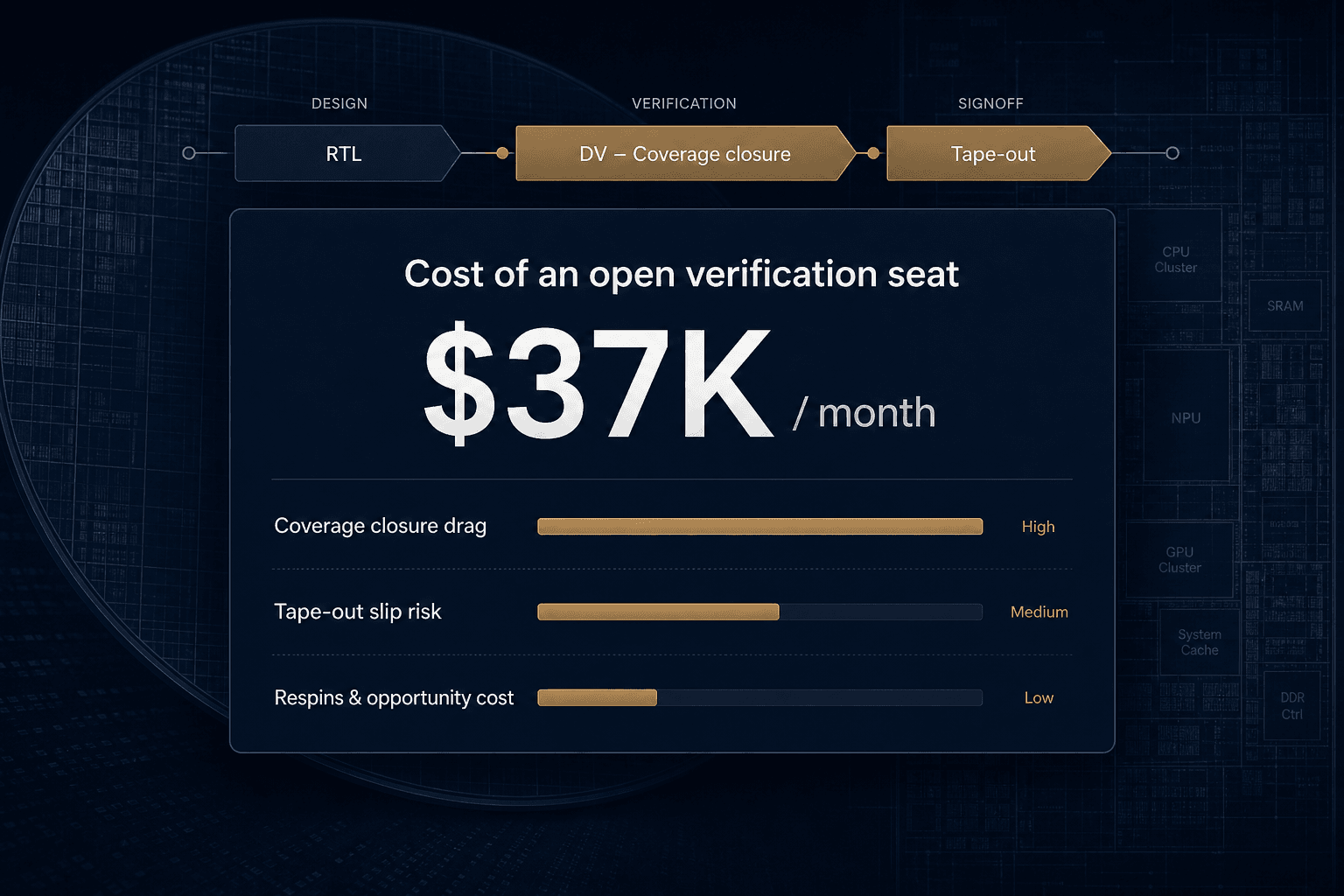
An open verification seat looks like a saved salary line and behaves like the most expensive item on your program. Here is a transparent, plug-in-your-own-numbers way to put a monthly dollar figure on a vacant DV seat before tape-out. The ~$37K/month model below is illustrative, not a universal claim.
Leave a verification req open and the budget line looks better every month. One principal DV salary you are not paying. On a spreadsheet that reads as savings. On a chip program eight weeks from tape-out it reads as the most expensive line you own, because verification sits on the critical path and the meter runs whether the seat is filled or not.
Below is a way to put an actual monthly number on that vacant seat, using assumptions you can swap for your own. The figure this illustration lands on is about $37,000 a month for one open principal verification seat before tape-out. Treat it as a model to adapt, not a universal number.
The Mistake: Treating an Open Req as a Saved Salary Line
From a finance seat, an open role is a deferred cost. From a delivery seat, the work still has to happen; it just happens later, or lands on someone else, and the tape-out date does not move to accommodate either. The saved salary is real. It is also small next to what the vacancy does to the schedule. HR has a name for this gap: cost per hire measures what you spend to fill a role, while cost of vacancy measures what the business loses while the role stays open (SHRM). For a critical-path engineering seat, the second number is the one that hurts.
The Real Cost Drivers
Four things drive the true cost, and none of them show up on the salary line you saved.
- Slipped coverage closure. Verification is usually the largest team on a chip program, often two to three times the size of the design team, and coverage closure is the long pole before sign-off. Pull an engineer out of that pole and the pole gets longer.
- Tape-out schedule risk. Verification gates tape-out. A slip there pushes the mask order, the wafer start, and every downstream milestone with it.
- Respin exposure. Verification is the insurance policy against a silicon bug, and a bug that escapes to silicon costs a $1M to $10M+ respin. At advanced nodes a mask set alone runs $10–20M at 3nm, and total design cost climbs into the hundreds of millions per node.
- Opportunity cost. A delayed tape-out delays revenue and can miss a market window that does not come back.
A Simple Framework to Estimate Your Own Per-Month Figure
You do not need a finance model to get a defensible number. Adapt the cost-of-vacancy method to a chip seat: instead of a generic revenue-per-head figure, add the seat’s output value, the drag it puts on the critical path, and the risk it exposes you to. Here is the illustration, for one open principal DV seat during coverage closure:
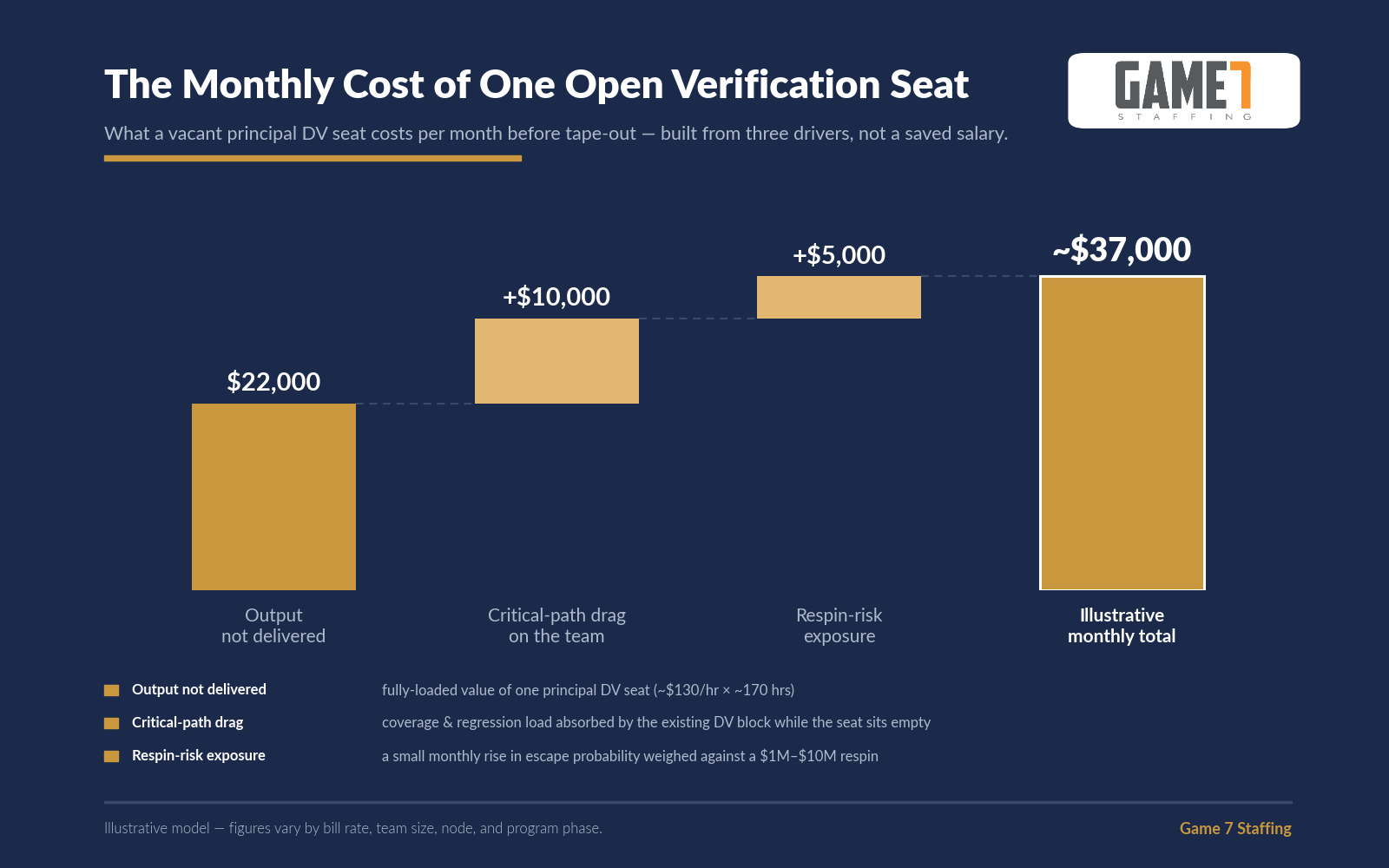
Swap in your own bill rate, team size, and respin exposure and the total moves, but the shape holds: the output gap is the floor, the critical-path drag is usually larger than people expect, and the respin term is a small probability against a very large number. Notice what is not in the table: the salary you saved. Against $37,000 a month of exposure, it is a rounding error.
Why Verification Seats Carry Outsized Schedule Leverage
Not every open seat is equal. A verification seat sits on the critical path in a way many roles do not. Coverage closure is sequential and it happens late, the DV team is the largest on the program, and it is the last gate before you commit millions of dollars to a mask set. An open DV seat during coverage closure carries far more schedule leverage than the same vacancy would three months earlier in the design phase. That is why the per-month cost of this particular seat runs high: it is the one closest to the money and the deadline at the same time.
What Speed of Fill Is Actually Worth Against a Tape-Out Date
If an open verification seat costs on the order of $37,000 a month near tape-out, then speed of fill stops being an HR metric and becomes schedule protection. Closing the seat a month sooner is roughly one unit of that figure in avoided cost, before you count the reduced probability of a slip, which is where the truly large numbers live.
This is the case for a specialist partner over a generalist req that sits. Game 7’s funnel for principal-level chip, board, and embedded engineers runs under 24 hours to first submission and a 19-day median to offer. On the illustration above, every month of fill time you remove is about $37,000 of exposure you either carry or you do not. And because two in three of the engineers we put in front of a hiring manager get an offer, your team is not burning its own coverage-closure hours screening a stack of misaligned resumes to get there.
If you have a verification seat open with a tape-out date in front of it, waiting is the expensive option. Tell us the block, the methodology, and the date, and we will put a shortlist in front of you.
FAQ
Frequently Asked Questions
How Do I Calculate the Cost of an Unfilled Engineering Role?
Start from cost of vacancy, not cost per hire. Add three things for each month the seat is open: the fully-loaded value of the output not being delivered, the drag the vacancy puts on the rest of the team’s critical path, and the expected value of the risk it exposes you to (for verification, respin and schedule risk). For a critical-path seat, that total dwarfs the salary you are not paying.
Isn’t an Open Req Just Saved Salary?
Only on paper. The salary is a real saving, but it is small next to what the vacancy costs a program that has a fixed deadline. The work does not disappear; it slips or shifts onto others, and near tape-out that slippage carries schedule and respin risk worth many times the monthly salary.
Why Are Verification Seats More Costly to Leave Open Than Other Roles?
Because they sit on the critical path at the worst possible moment. Coverage closure is sequential, happens late, and is the last gate before a multi-million-dollar mask commitment. Verification is also the largest team on most chip programs, so a single vacancy slows the longest pole in the schedule.
What Is the $37,000 Figure Based On?
It is an illustration for one open principal DV seat during coverage closure: roughly $22K in output not delivered, $10K in critical-path drag on the team, and $5K in respin-risk exposure. It is a model to adapt with your own bill rate, team size, node, and program phase, not a universal claim.
How Much Is Filling the Seat Faster Actually Worth?
Roughly one month of the per-month figure for every month of fill time you remove, plus the harder-to-quantify reduction in slip probability. If a seat costs about $37,000 a month near tape-out, every month you cut from fill time is real money kept on the program, not a soft HR benefit.
Written by
Game 7 Staff