
The Contract Engineer’s Resume: What to List and What Technical Screens Actually Read

What to put on a chip, board, firmware, or mechanical engineering resume, and the red flags technical screens catch in the first 90 seconds.
Your resume clears a keyword filter and a non-technical recruiter before an engineer who understands your work ever opens it. By the time it reaches someone who can read it, you have roughly 90 seconds of their attention. Most senior engineers spend those 90 seconds working against themselves: the few lines that decide the outcome are buried under a decade of bullet points, and the summary paragraph at the top could describe half the field.
We place chip, board, firmware, and mechanical engineers into Fortune 500 programs, and we screen these resumes every day. The read looks for the same three things whether the role is an RTL designer, a signal integrity engineer, a firmware lead, or a mechanical principal. Here is what that read is hunting for, and what quietly sinks strong candidates.
The Three Signals a Technical Screen Reads First
A hiring manager scanning for a specialist is not reading your resume top to bottom. They are hunting for three signals, and they find them fast or they move on. The signals are universal; the proof looks different in each discipline.
Proof you shipped real hardware. Shipped work is the strongest line on any engineering resume, because it proves you have lived through the consequences of your own decisions. Name the milestone your discipline actually ships to. In chip design that is a tape-out. On the board side it is a design that cleared DVT and reached production. In firmware it is silicon bring-up and code deployed in the field. In mechanical it is a design released to production that passed qualification. State the count and what you owned: “Three tape-outs; owned timing closure” or “Released the enclosure to production; passed MIL-STD-810 vibration.”
Your domain and its standards. The vertical you worked in reshapes what your experience is worth, and the governing standard is the fastest way to signal it. A process node (3nm, 5nm, 28nm) does this for front-end and physical design, because closing timing at 3nm is a different problem than at 28nm. Everywhere else, the standard carries the weight: ISO 26262 and an ASIL level for automotive, DO-254 and DO-178C with a DAL for aerospace and defense, IEC 62304 for medical, IEC 61508 and a SIL rating for industrial. Naming the standard tells a screener you have worked inside that domain’s process rigor, not around it.
Your exact tools, per discipline. Tool names place you in the ecosystem in one glance. SystemVerilog and UVM with VCS or Xcelium says verification. ICC2 or Innovus with PrimeTime says physical design. Allegro or Altium with HyperLynx says board. FreeRTOS and C with a Lauterbach debugger says firmware. SolidWorks or Creo with Ansys says mechanical. Vague phrasing like “industry-standard tools” reads as someone who has not used them.
Discipline By Discipline: What Signal to Lead With
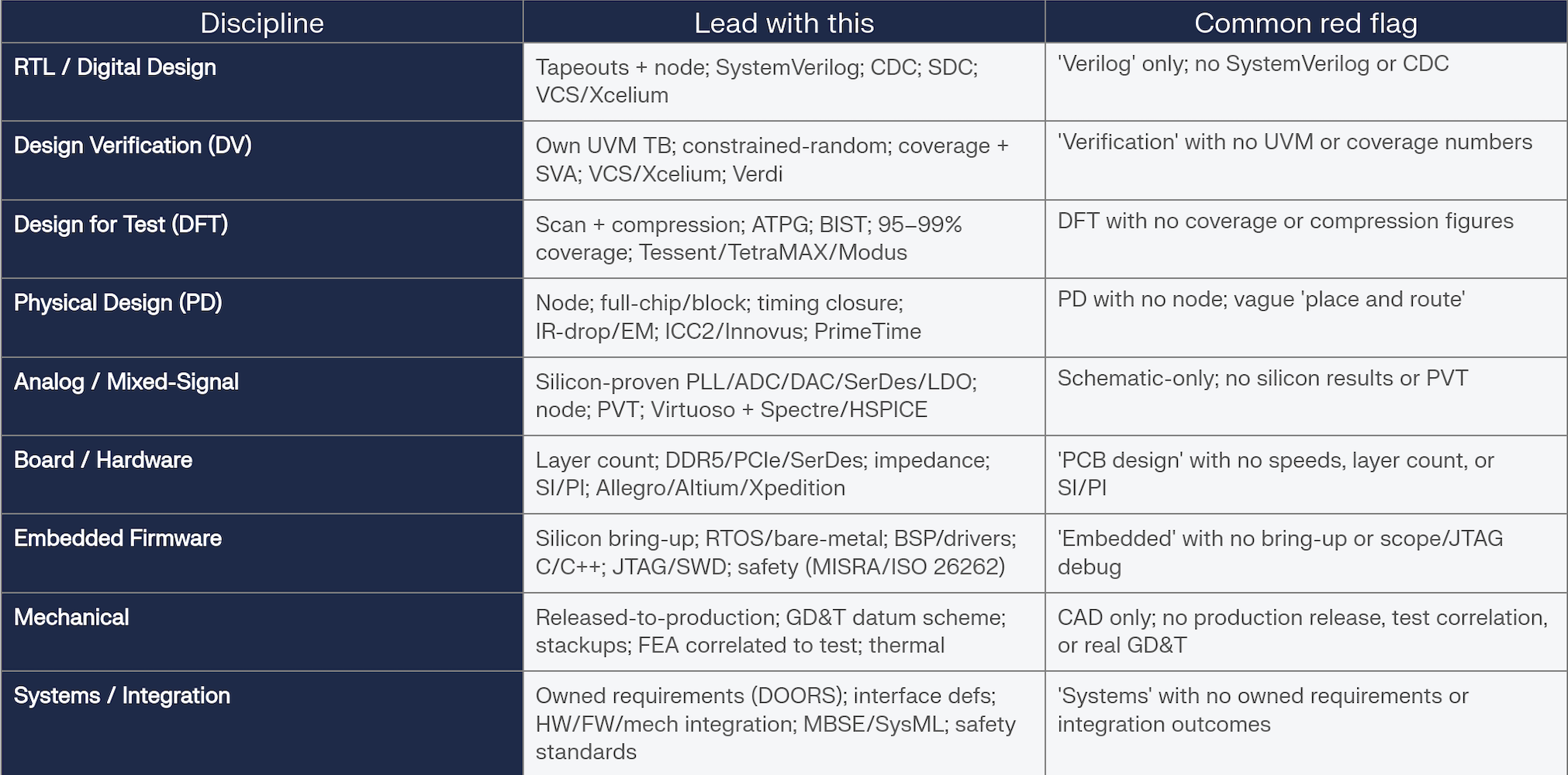
The three signals matter for everyone, but the specific proof differs by discipline. Lead with what a screener in your field is actually hunting for.
Red Flags You May Not Know You’re Showing
The gaps below rarely feel like gaps to the person writing the resume. To a technical screener, each one is a tell.
On the digital side, listing “Verilog” alone with no SystemVerilog constructs reads as legacy or thin experience, and a design resume with no clock domain crossing exposure stands out for the wrong reason, since many of the verification escapes that kill chips happen at CDC boundaries. Physical design resumes that describe the flow but omit the node are the single most common miss: “ran place and route and closed timing” could mean 28nm or 3nm, and those are close to different jobs.
Analog has its own trap. Pages full of schematic-capture and simulation with no mention of silicon results or PVT corners suggest designs that never went to fab or never came back measured. Board resumes fall into the same pattern when they say “PCB design” with no interface speeds, layer count, or SI/PI work behind it, which is the difference between a 4-layer sensor board and a 20-layer backplane with 112G channels.
Mechanical resumes lose credibility two ways: FEA results presented with no correlation to physical test, and a long CAD tool list with nothing released to production. A screener wants to see that your simulation predicted what the hardware actually did, and that a part you owned shipped. Firmware has the parallel tell: “embedded experience” with no silicon bring-up and no scope- or JTAG-level debug reads as application code, not firmware.
What to Leave Off
Every line that does not support your three signals is competing with them for those 90 seconds. Cut coursework tools and academic licenses; a screener assumes you can learn a tool, and a university MATLAB license next to your production flow reads as filler. Cut percent-complete side projects, which raise more questions than they answer at the senior level. Cut the buzzword stack, the ten-deep list of protocols and languages you touched once, because it dilutes the four or five you actually own, and a technical reader can tell the difference in seconds.
Skills you used once belong in a conversation, not on the line that is supposed to prove depth.
Formatting for a 90-Second Technical Read
Put your strongest shipped-work, domain, and tool signals in the top third of page one. A skimming screener should hit them before scrolling. Under each role, lead the first bullet with what you owned and delivered, then follow with the tools and the outcome. Keep it to two pages; a fourth page of early-career detail buries the recent, relevant work that earns the interview.
Use plain formatting that survives a resume parser. Tables, text boxes, and two-column layouts often scramble when the applicant tracking system reads them, and a garbled parse is what a non-technical recruiter sees first. A clean single-column document with real section headers gets through intact.
Contract-specific Notes: Engagement Outcomes, Extensions, and How to Show Them
Contract work has its own signals, and they read as strengths when you frame them well. List the engagement length and the deliverable, not just the dates: “9-month contract; brought up the BSP and delivered the driver stack for a new automotive SoC” or “6-month contract; owned the thermal redesign that passed HALT on the second build” shows scope and closure. Extensions are proof of fit, so say when a contract was extended, because a hiring manager reads that as a prior team choosing to keep you.
A run of shorter engagements across different programs is not a liability at the senior level; it is range, provided each entry names the domain and what you shipped. The thing to avoid is a list of company names and dates with no deliverable attached, which reads the same whether you drove the work or filled a seat.
One note on how the match works on our side: the engineers we submit rarely burn interview cycles, because the calibration happens before the submit, not during the interview. A resume that states its three signals clearly is what makes that possible. The clearer your shipped work, domain, and tools, the faster a real match gets made.
Resume Checklist: Do / Don’t
Do
✓ Lead with shipped work: the milestone your discipline ships to, the count, and what you owned.
✓ Name the domain and its standard (node for chip; ISO 26262, DO-254, DO-178C, IEC 62304 for the vertical).
✓ Name exact tools per discipline (VCS/Xcelium, ICC2/Innovus, PrimeTime, Virtuoso/Spectre, Allegro/Altium, FreeRTOS, SolidWorks/Creo, Ansys).
✓ Show the discipline’s proof metric: coverage %, PVT corners, interface speeds, FEA-to-test correlation, qualification passed.
✓ State contract length, deliverable, and any extension.
✓ Keep it to two pages, single column, parser-safe formatting.
Don’t
× Claim shipped work with no role or milestone (“participated in tape-out,” “worked on the board”).
× List “Verilog” with no SystemVerilog depth, or claim digital design with no CDC exposure.
× Describe place-and-route or timing closure with no process node.
× List a CAD tool stack with nothing released to production, or FEA with no test correlation.
× List coursework tools, academic licenses, or percent-complete side projects.
× Pad a ten-deep buzzword stack that hides the tools you actually own.
If your shipped work, domain, and tools are on the page, we can match you to teams where your depth actually matters, and we won’t waste your time with misaligned roles.
Submit your resume, have us take a look to optimize it, and see what's a perfect fit for you today.
FAQ
Frequently Asked Questions
What should an engineer put on a hardware, firmware, or mechanical resume?
Lead with shipped work. A technical screen reads three signals first: proof you shipped real hardware, the domain and standards you worked under, and your exact tools per discipline. Shipped means a chip tape-out, a board that reached production, firmware deployed in the field, or a mechanical design released to production and qualified. Tools mean SystemVerilog and UVM with VCS or Xcelium for verification, Allegro or Altium for board design, FreeRTOS or Zephyr with C for firmware, and SolidWorks or Creo with Ansys for mechanical. Everything else supports those signals.
How do you show shipped work on an engineering resume across disciplines?
Name the milestone your discipline ships to, the scope, and what you owned. For chip design: “Three tape-outs; owned block-level timing closure on a 5nm SoC.” For board: “Took a 16-layer PCIe Gen5 board from schematic to production.” For firmware: “Brought up the BSP and shipped the driver stack on a new automotive SoC.” For mechanical: “Released the enclosure to production; passed MIL-STD-810 vibration and HALT.” A screener needs to know you drove it, not that you were nearby.
Should you list a process node or a compliance standard on a resume?
Yes, both, wherever they apply. For front-end and physical design, the process node (3nm, 5nm, 28nm) is a primary qualifier because the problem changes completely between nodes. For any discipline in a regulated vertical, the governing standard is the qualifier: ISO 26262 and ASIL level for automotive, DO-254 and DO-178C with DAL for aerospace and defense, IEC 62304 for medical. Listing the standard tells a screener you have worked inside the process rigor that domain demands.
What are the biggest red flags technical screens catch on an engineering resume?
Discipline-specific tells that signal thin depth: “Verilog” with no SystemVerilog constructs and no clock-domain-crossing exposure; physical design work with no process node; analog schematic work with no silicon or PVT corners; “PCB design” with no speeds or layer count; “embedded” with no silicon bring-up or scope-level debug; and FEA results with no correlation to physical test. Coursework tools, percent-complete projects, and long buzzword stacks add noise and bury the signals that matter.
Written by
Game 7 Staff